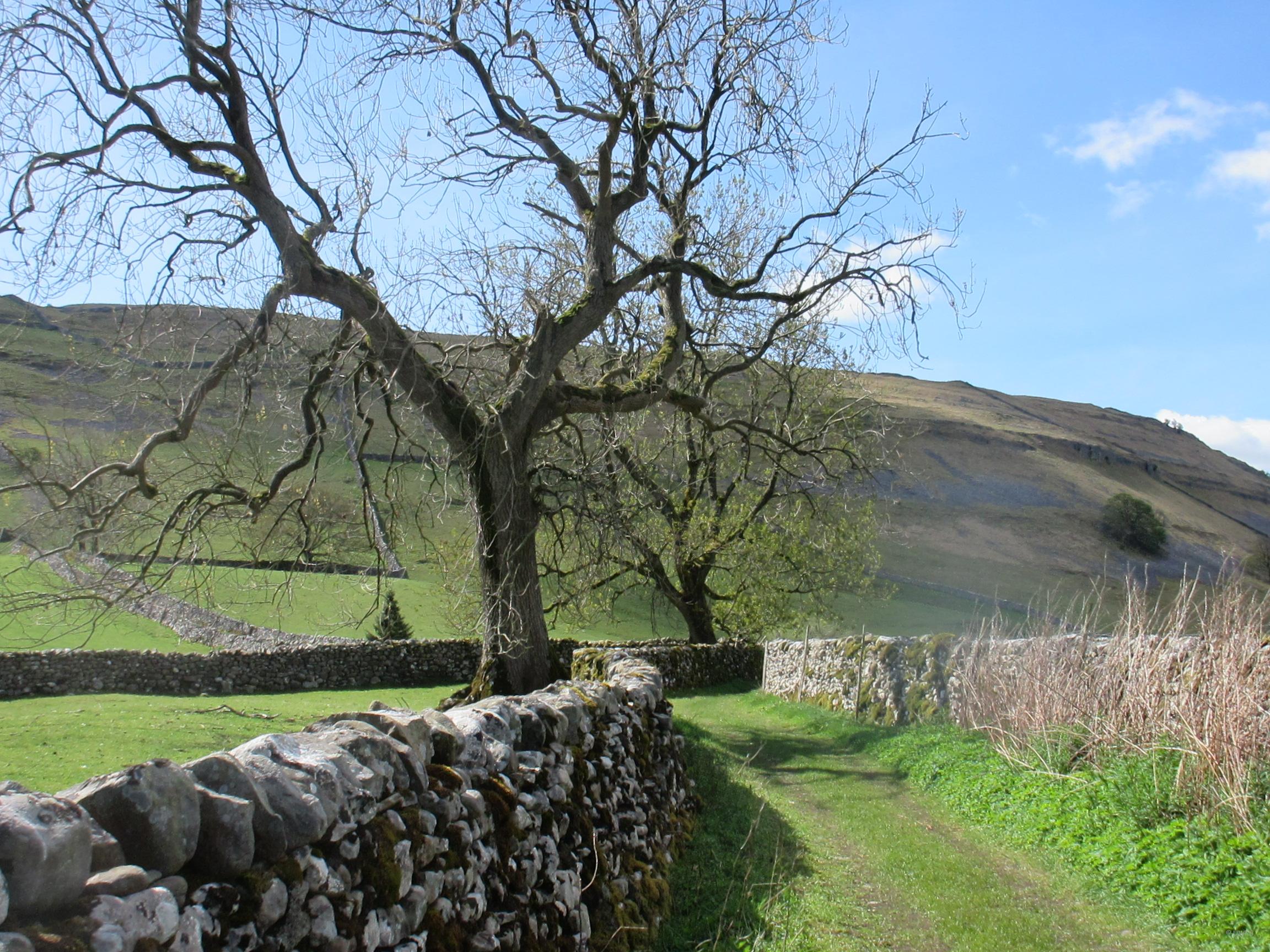
This April sunny day displayed the grandeur of this old church of St. Andrew and the surrounding ‘park’ of memorial stones. Known as ’Lang Kirk’, the ancient weathered stonework of this extended church reveals features of skilled masons and carpenters from centuries past, the oldest part of the current building being 11th/12th century. It stands on a hill overlooking the Aire valley where routes have long converged and the river bridged, the village of Kildwick clustered around. The age-old history of this site of worship is easily understood, and inspired our interest.
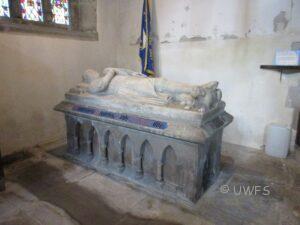
Kildwick Church de Stiverton effigy. Image Phyllida Oates.
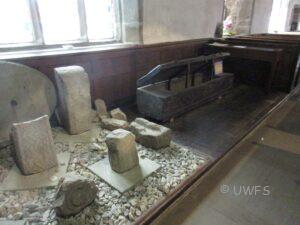
Kildwick Church Parish chest and Viking stones. Image Phyllida Oates.
Before even the Conquest and the Domesday survey, in a period of late Anglo-Saxons, evidence has been revealed of an early church, of wood and thatch, wattle and daub, but with a stone altar. Sections of Pre-Norman stone crosses and of early pillars were re-used in restoration work, the crosses of Scandinavian design dated 9th/10th century, with skilled celtic patterns clearly visible. From the time between 1135 and 1140 when Cecily de Romilly granted the church to the Priory at Embsay, progressing to Bolton Priory until the Dissolution of the Monasteries in 1539, the ‘ownership’ of the church was with the following Lords of the Manor or the Crown, then the stewardship of joined parishes Kildwick, Cononley and Bradley.
Restorations and expansions took place during 1320, the mid-15th century, the 16th century, resulting in the church being abnormally long, headed by its 14th Century tower.
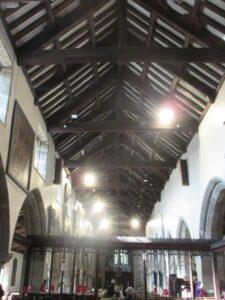
Kildwick Church 16th century oak roof. Image Phyllida Oates.
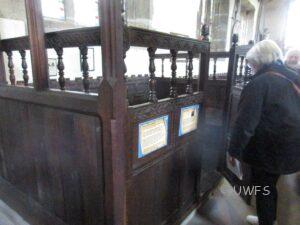
Kildwick Church Eltofte box pew. Image Phyllida Oates.
Evidence of all these generations exist in the church today – the magnificent 16th century oak roof beams and trusses, the Eltofte 14th century box pew, 17th century pews and general woodwork throughout, beautifully and skillfully carved, the stained glass windows revealing the Coats of Arms of de Romilly, the Priors of Bolton Priory, and relevant prominent families such as Currer, Eltofte, Swire.
Externally, in a churchyard of beautiful spring flowers, are many very interesting gravestones, including commonwealth war graves, and an amazingly finely detailed stone replica organ marking the final resting place of John Laycock, an organ builder from Glusburn.
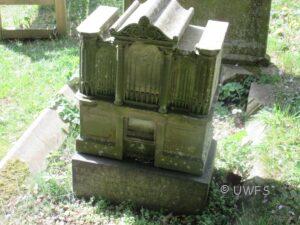
Kildwick Church Organist grave. Image Phyllida Oates
In 2021 St. Andrews was designated as a major parish church, a Grade II listed building, which makes a ‘considerable civic, cultural and economic contribution to their community.’ Our History Group absorbed the experience with considerable interest, and were grateful for the company of Graham Taylor who has much knowledge of the church, and is leader of the Farnhill and Kildwick History Group.
Kildwick Church Group is refreshed. Image Phyllida Oates.
Phyllida