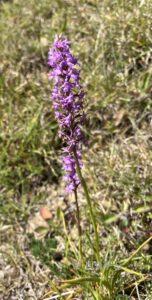
Marsh Fragrant Orchid Gymnadenia densiflora
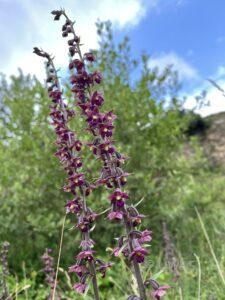
Dark Red Helleborine Epipactus atrorubens
Seven members of the UWFS botany group headed to Bishop Middleham Quarry on a warm, sunny mid-July day. After weeks of little or no rain, the site was very dry but we still enjoyed our time there. Formerly a magnesian limestone quarry, it was abandoned in the 1930s (there is still an active quarry nearby) and since then has become a haven for plants, butterflies and birds. Some members of our group had been on the visit to Burton Leonard Lime Quarries a couple of weeks beforehand, also magnesian limestone, and there were lots of similarities between the two sites but the mix of plants and the dominance or otherwise of particular species was different.
We started at the top of the quarry and enjoyed seeing our first Dark Red Helleborines Epipactis atrorubens (for which the quarry is rightfully famous) as well as Common Spotted Dactylorhiza fuchsii and Fragrant Orchids. There are three species of Fragrant and telling them apart is not easy but we concluded that lip shape, colour, density of flowers and the time of their flowering probably implied that most, if not all, of the plants we saw were Marsh Fragrant Gymnadenia densiflora. Restharrow Ononis repens was everywhere in the quarry as were both Field Scabious Knautia arvensis and Small Scabious Scabiosa columbaria, Common Rock-Rose Helianthemum nummularium and patches of Eyebright sp Euphrasia.
Dropping down to the base of the quarry, we found many more flowering spikes of Dark Red Helleborines as well as some old spikes of Bee Orchid Ophrys apifera. Hiding out of the full sun were a particularly fine pair of Pyramidal Orchids, Anacamptis pyramidalis – those out in the sun were already starting to go over. Common Twayblades Neottia ovata were also in abundance.
We met a man doing a butterfly transect who also helps with the annual count of Dark Red Helleborines. In 2025, they counted over 3500 plants making it a very important site in Europe for this lovely plant. Interestingly, all the plants seem to be uniformly dark red whereas those at Hutton Roof, for example, show more variety. We also enjoyed all the butterflies and moths around and identified Small Heath, Common Blue, Meadow Brown and Dark Green Fritillary amongst many others enjoying the flowers.
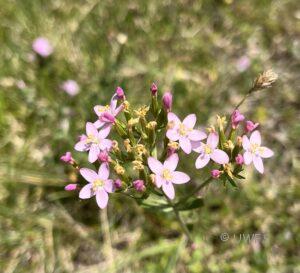
After lunch, we continued exploring the base of the quarry finding a number of Autumn Gentian Gentianella amarella plants emerging. Finally, we faced the climb back out of the quarry and up to a higher area where we saw fine examples of Common Centaury Centaurium erythraea and a rather scruffy couple of plants of Blue Fleabane Egigeron acris. There were also many more Dark Red Helleborine plants – they seem to be doing very well at this site. We saw and heard a number of birds including a ‘charm’ of goldfinches, long-tailed tits and linnets.
Finally, we headed back to the entrance and our cars to head south having had a lovely time in this exquisite reserve.
Photos and report by Jane Welsh
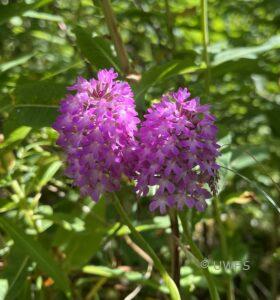
Pyramidal Orchids Anacamptis pyramidalis