
MONASTIC ARNCLIFFE

Botany Lane Arncliffe. Phyllida Oates
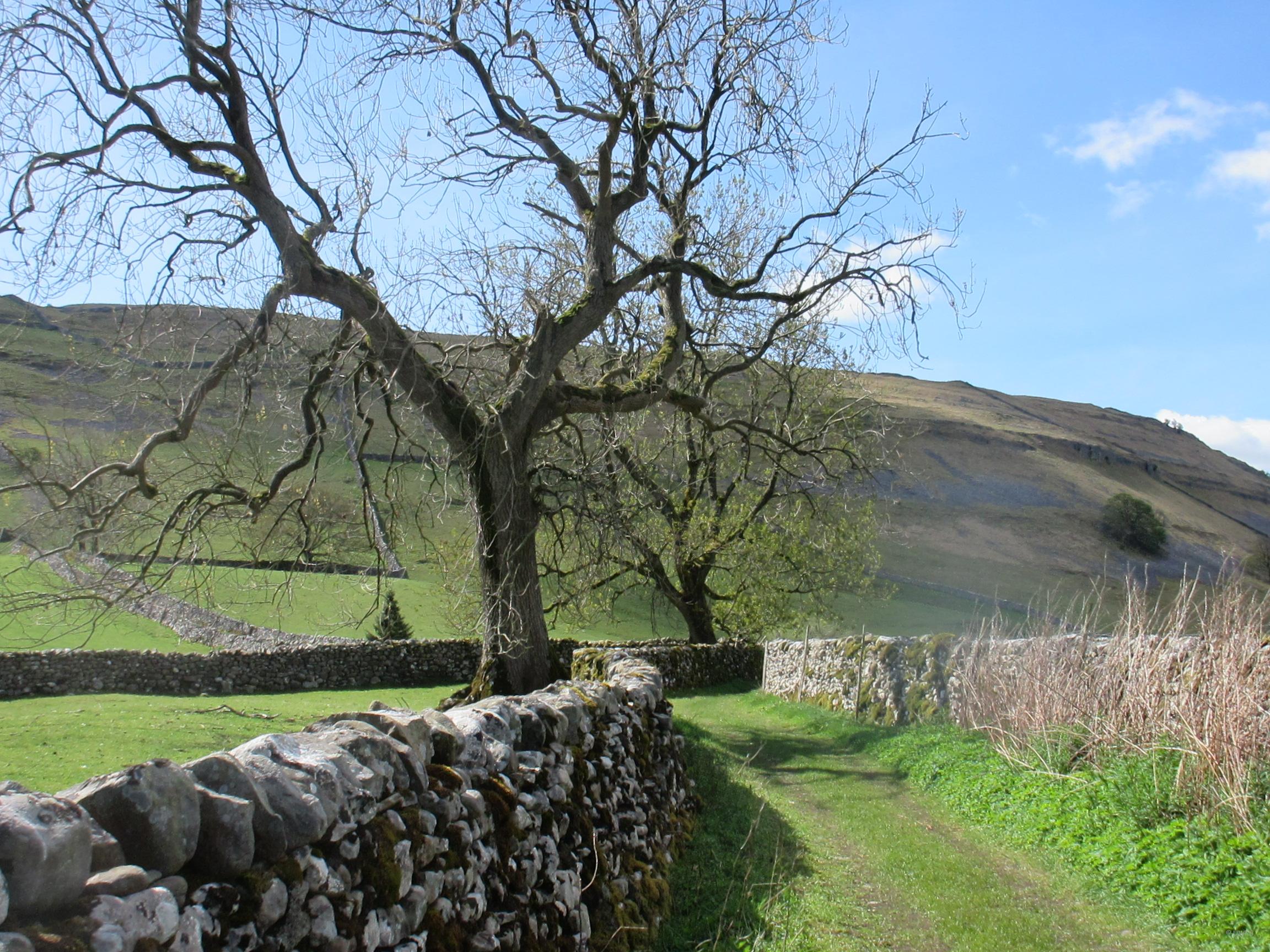
The Group returned to Arncliffe on Thursday, 28th May, to reflect on the influence in the community of the occupation of Fountains Abbey’s Cistercian monks in the 13th-16th centuries. Following an introduction to set the scene and explain the background, and viewing Old Cote across the river, we walked from St. Oswald’s Church to Botany Lane which continued as the Monks Road to Malham. A view point from Botany House showed the broad landscape of worked farmland, and also the remains of the millpond for the 14th century cornmill. There was much discussion on stonework evidence of the early mill, a sluice, and the overgrown leat from the millpond when we walked on Brootes Lane beside Cowside Beck. Brootes Lane was the ancient route to Darnbrook, another of Fountains Abbey granges, and on to Great Close and Malham. Overall we needed to use our imagination and absorb the atmospheric landscape to try and understand life here in monastic times.

Overgrown Mill Pond Arncliffe. Phyllida Oates.
Arncliffe at that time was a settlement of the Anglians who founded the village and named it. They were modest farmers, providing for their families in their wood and thatch homes, and making ingenious use of the landscape. It was the Anglians who created the terraced cultivation (lynchets) on the fell slopes and a rotation system, the valley floor being too marshy for crops at that time but suitable for livestock grazing. Domestic animals would be kept close to their homes, and the extensive but not dense woodland would provide fodder for the pigs. Fruit trees, herbs and wayside plants, and bees were also valuable resources……….a simple but often harsh existence.

Clowder Arncliffe. Phyllida Oates.
Where the church of St. Oswalds stands, spiritually important beside the running river Skirfare, was almost certainly an Anglian place of worship before the original church was built in 1100 AD. The de Arches family (later known as Darcy) were Lords of the Manor of Arncliffe then, apportioned by William de Percy who had been granted huge areas of Northumberland and Yorkshire by King William. Following the Domesday Survey of 1086 Percy enclosed the whole area of Littondale Forest for hunting and cultivation. The ‘forest’ was actually a landscape of scrub trees with mostly ash and hazel.

Mill Structures Cowside Beck Arncliffe. Phyllida Oates
Then in came the Cistercian monks of Fountains Abbey. Monasteries existed much earlier in England, from about the 5th century, with educated monks who could read and write and create magnificently illustrated manuscripts of learning, but they were almost entirely enclosed Orders, confined within the Abbeys. But when the monastic Orders from France followed King William and established their Abbeys they were not only educated but were industrious and understood economics, and integrated with communities.
Fountains Abbey was founded in 1132 and soon was expanding its estate and establishing a workforce of lay brothers from the peasant communities who vowed to keep to monastic rules. The monks realised the value of sheep and their fleeces in this northern region, and as they acquired their land, established outlying granges, they developed a huge industry in sheep farming. English wool was in great demand in the 13th century, and sales to the continent of surplus supplies brought high profits. The habits worn by the monks were of low quality wool, the ‘choir’ monks in fleece-white habits, the lay brothers in brown habits, and animal skins were also worn in winter months.

Presumed Mill site Arncliffe. Phyllida Oates
In 1175, before monks arrived in Arncliffe, the manor of Hawkswick was held by William de Mauleverer who granted some land to Fountains Abbey and access over bridges on the rivers Skirfare and Wharfe, which the Abbey was required to maintain. Later, Thurstin de Arches bought all the remaining estate of Mauleverer and granted the entirety to the Abbey, which extensively increased their land-holding. (Substantial earthworks around Arncliffe Cote and Hawkswick Cote have been investigated by archaeologists which appear to be medieval and likely related to monastic occupation.) About forty grants of land were actually made relating to Arncliffe and the Abbey, in exchange for prayerful monks to consider these benefactors as worthy of God’s pleasure, for the salvation of their souls. Grants gave right of tenure and the income from the land, but not absolute ownership as the land was returned to the King or family control later.

Identifying Mill leat Arncliffe. Phyllida Oates
Presumably the settled Anglians retained their dwellings and much of their life in their village when the monks began to establish their presence, but they became tenant farmers of the Abbey and had to comply with the productive management of sheep. A monastic grange complex was established, at Old Cote. In fact, the current 17th century building is on the footings of the grange, and it is thought that there is evidence of the original building behind Old Cote.
Grange buildings were highly functional agricultural complexes. The buildings were frequently combined under a single roof, including shared dormitories for lay brothers, basic kitchens and secure storage for farm tools, harvested grain and animal fodder. There would need to be adjacent folds, byres and stables for livestock. The brothers slept on straw mattresses covered with single blankets or animal skins. They were better fed than ‘choir’ monks because of their hard and long labour, from daybreak to dusk, disciplined, often solitary workers and required to allow prayer-times in each day.

Mill Gate Arncliffe. Phyllida Oates
The number of lay brothers necessary at a lesser grange like Arncliffe would be about ten, with a grangemaster in charge, managing wool production from probably 300-400 sheep. Neighbouring Kilnsey was a more prominent grange, with its own chapel, and up to twenty brothers.
(Fountains Abbey, at the height of its prosperity, would have had 800 lay brothers, most of them allocated to outlying granges……..until the depopulation from the Black Death plague in the 14th century when surviving PEASANTS became more valuable workers.)
Lay brothers at Arncliffe were responsible for rearing sheep for the best quality wool, shearing, dipping, treating the fleeces against parasites with a kind of ‘tar’, and cultivating land for produce for their community and for the livestock. In the more marshy pasture hemp (ditchweed) would be grown as this fibre was harvested and prepared to use as twine and making sacking for the fleeces. Stock was seasonally moved to trading areas, mostly at Great Close, Malham, using the established tracks, lanes.
Monks travelled on foot frequently to and from the Abbey, across the open moors on well-trodden routes, but more substantial tracks on lower levels were necessary for oxen-driven carts carrying heavy goods, and for moving livestock.
Fountains Abbey had secured most of Littondale, all Malham Moor and much of Malham, and all Bordley. At the Dissolution of the monasteries in 1539 these lands were returned to the Crown. Through the Augmentations Office, many of the lands were sold as large areas, either to local lords or to local families who may have been holders under the monasteries. Much of Littondale land was sold initially to Sir Richard Gresham and on to the Cliffords of Skipton Castle. Sheep farming continued as a prosperous industry, and the huge wool and textile milling industry developed………
Phyllida Oates
Sources of reference:
Upper Nidderdale Landscape Partnership
Nidderdale History Group: ‘History of Nidderdale’
Arthur Raistrick: ‘Old Yorkshire Dales’
Sonia Wilkinson: ‘Kilnsey, a Dales Township’
Numerous websites


