After a long period of dry, hot weather, Malham Boardwalk was an ideal choice for our mid-August trip as all the moisture was keeping everything green and verdant. As we had visited the Boardwalk back in June, it was interesting to see how the site had developed and how the flora had changed. On a warm sunny day, with plenty of flowers around, we were also treated to lots of butterflies including Red Admiral, Peacock and various Whites.
The most striking thing as we entered the reserve, was the extent of Devil’s Bit Scabious Succisa pratensis across the site – where we had seen a few leaves earlier in the season, we could now enjoy a haze of soft purple. One of the other treats towards the end of summer were the Grass of Parnassus Parnassia palustris – their delicate white blooms scattered across the site.
Other highlights were a couple of aging spikes of Common Wintergreen Pyrola minor, Round-leaved Sundew Drosera rotundifolia and the ripe berries of Cranberry Oxycoccus. As we passed the raised bog area, we enjoyed the flowering Ling Calluna vulgaris.
After lunch, we had an introduction to the identification of ferns learning the importance of counting the number of pinnates on the fronds, the different shapes of spores and the overall shape of the fronds. On the way back, we put this knowledge into practice, with varying levels of success, differentiating between Lady Athyrium filix-femina, Male Dryopteris filix-mas, Narrow Buckler-Fern Dryopteris carthusiana and Broad Buckler-Fern Dryopteris dilatata.
Almost back at the start of the Boardwalk, we spotted some yellow, snapdragon-like flowers emerging from a pond. Further research identified it as a Bladderwort. These rare plants are free-floating and don’t put down roots. The leaves are finely pinnately divided and carry many bladder-like traps. These are equipped with trigger hairs to suck in and digest small zooplankton. Back home, we were able to establish that Greater Bladderwort Urticularia vulgaris is the most likely plant to be found on the Boardwalk. Unfortunately, we couldn’t get close enough to get a decent photograph.
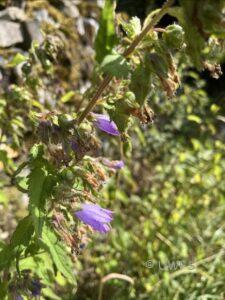
Back at the gate, we had a final opportunity to look at the Nettle-leaved Bellflower Campanula trachelium which shelters by the wall. This is a relative rarity this far North but a changing climate might improve conditions for it. All in all, it was a delightful visit and a reminder that this site is worth exploring at many different times of year and definitely a good destination in a dry summer.
Report and photographs by Jane Welsh
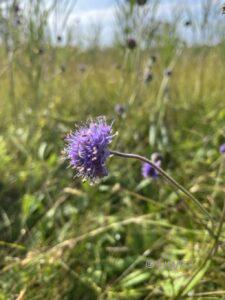
Devil’s Bit Scabious Succisa pratensis
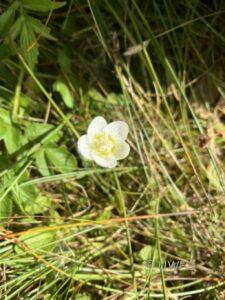
Grass of Parnassus Parnassia palustris
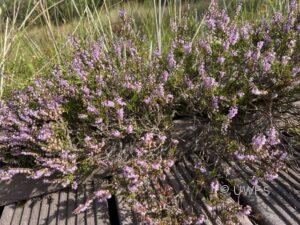
Ling Calluna vulgaris