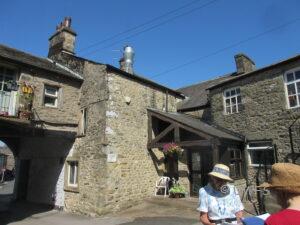
Talbot Yard Settle. Photo Phyllida Oates
Frances and Marion compiled a ‘journey’ in Settle, with appreciation of past social history in this ancient township on a long-established east/west route for trade and travellers. So many buildings and structural features of centuries past have retained their external appearance, especially from the great rebuild of the 17th century, although of course much modern improvement developed internally. Documentary evidence exists however of much earlier build and occupations.
The old market was granted by Henry III in 1249, ideally placed with well used links to all surrounding areas. Service industries, retailers, craftsmen and women helped develop a growing economy, in addition to the already established agricultural importance. By the end of the 18th century there were dressmakers, tanners, boot and shoemakers, millwrights, tallow chandlers, and cotton manufacturers. Inevitably innkeepers and licensed victuallers generally thrived, and essential professions established in the 19th century – banks, legal services, medics and schools.
Quaker Meeting House. Photo Phyllida Oates
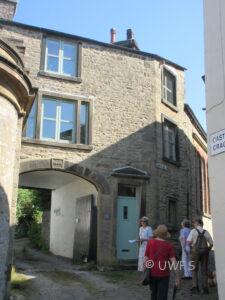
Bishopdale Court. Photo Phyllida Oates
Some of the larger commercial buildings in the town were built by Quaker business families. In the mid-17th century preachers came to Settle, to be attacked by some and listened to by others who later formed the first group of the Society of Friends in the town.
Non-conformity continued in Settle, with Methodism which was first preached in 1743, by Benjamin Ingham. Others followed, which resulted in a room being rented in Kirkgate in 1771. John Wesley preached here in 1784, and a parcel of land was purchased “whereon stood a chapel” in Chapel Lane, replaced by the grander Bethesda Chapel in 1810, with a Sunday School in a rented room in The Folly. In the later 1800s land with a cottage and a former smithy was bought on Chapel Square where a schoolroom was built in 1881 and used until 1930 when it was bought by Freemasons. Primitive Methodism also established a chapel, Ebenezer Chapel, with the belief that the original Methodism was not being fully adhered to. This site was then occupied by the Parish Church but it is now a private house. A Zion Chapel was also built, in 1816, at one of the highest points in the town – Zion was an Old Testament hilltop fortress captured by King David and was the oldest part of the city of Jerusalem. A group based in the industrial West Riding known as The Itinerants endeavoured to strengthen churches in rural areas. Their stirring preaching drew great crowds in Settle and raised funds, and, together with a further donation from the Itinerant Society, and Zion Chapel was erected on land purchased from John Birkbeck. Various ministers tended the chapel, and members contributed in many ways to the life of the community, but the chapel closed in 2015. Settle’s Parish Church of the Holy Ascension was consecrated in 1838, built in the Early English style, with a wide nave and a polygonal bell tower, topped with a spire.
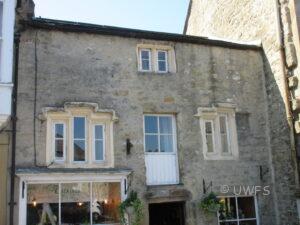
Interesting C17th Windows. Photo Phyllida Oates
A canal was proposed to be built in 1773 to link with the Leeds and Liverpool canal to carry stone out and coal into Craven, but local landowners objected sufficiently to prevent the project. We did locate, however, the building named Liverpool House.
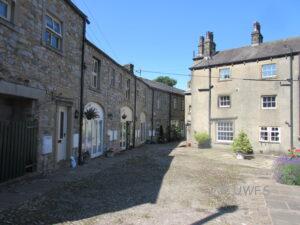
Courtyard of Marshfield House. Photo Phyllida Oates
In the early 19th century railway companies built their own tracks and charged other companies to run on them. The Midland Railway requested that its goods and passengers be carried by the London & North Western from Ingleton to Carlisle and Scotland, the station being in Giggleswick. The Midland Railway then built a new line in 1865 (the Settle to Carlisle line) which needed an Act of Parliament. It took seven years to complete due to the difficulty of the terrain.
By the early 19th century, and with the development of the textile industry, Settle had five mills where wool was being spun by machine. Three of these, Runley, Bridge End, and King’s Mill in Lower Settle were originally corn mills. Dog Kennel Mill and Brennands weaving shed were in Upper Settle. Snuff Mill in Lower Settle followed Kendal, which by the early 19th century was the leading snuff producer in Britain. Tobacco was brought into the western ports of Whitehaven, Workington and Maryport. Snuff Mill was rebuilt in 1830 after a fire and became known as King’s Mill, spinning cotton.
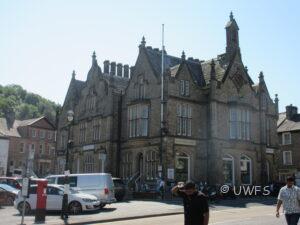
Settle Town Hall. Photo Phyllida Oates
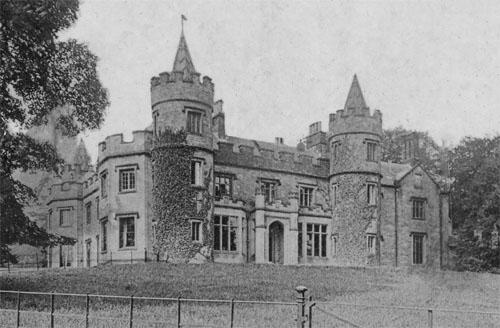
A great local character of Settle was Thomas (Tot) Lord, a prominent figure in the town and known to all. He was a greengrocer’s son, served in the Great War and, on returning, he started buying and selling. He was also a keen explorer of the abundant caves in the area and became a founder member of the Cave Rescue Organisation in 1935. His caves venture, most notably in Victoria and Attermire led to the discovery of a wealth of ancient material. Tot Lord bought Townhead in 1948, a dilapidated mansion overlooking Settle, and turned the ground floor into a museum which included the bones of exotic animals such as hyena, elephant, rhinoceros and hippopotamus. Townhead and Pig Yard Museum no longer exist, but Tot Lord’s memory definitely lives on.
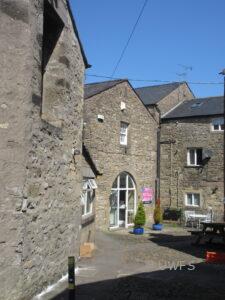
Old Laundry with Listed Gateposts. Photo Phyllida Oates
Our group was led through so much of Settle’s history, identifying feature buildings, into narrow alleys with interesting buildings huddled closely as in Bishopdale Court, viewing dominant Marshfield House with extensive gardens, courtyard and stabling, built c.1750 for Thomas Salisbury – the area now divided into flats. Many earlier inns have been re-established as other businesses or homes, but some are still functioning, such as the Talbot Arms and the Golden Lion. Where the Town Hall now stands was a tollbooth with a nightwatchman’s room and town lock-up, but in 1832 this architecturally impressive Town Hall was built, believed to be in the French style. The Shambles in the Square was originally an open market with barrel-vaulted cellars in c.1675. It was enclosed later that century and the arches added. Workshops and a slaughterhouse were in the basement, shops on the ground floor, single-storey dwellings above. In 1898 the 17th century dwellings were rebuilt and a second storey added by the Settle Market Buildings Company. The numerous gantries of early warehouses still exist but often have been converted into windows. We noted Dr. Buck’s house in the Square, where his great friend Edward Elgar visited regularly.
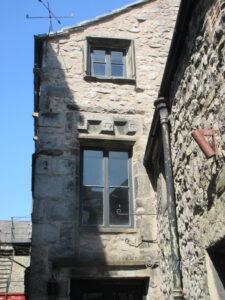
Unusual pediment for a window. Photo Phyllida Oates
Many prominent buildings belonged to the town’s prominent Quakers, such as Birkbeck and Sutcliffe. The Friends’ Meeting House was an interesting inclusion in our visit, with a datestone of 1678. The Quakers acquired a piece of land in 1661 for a peppercorn rent for use as a burial place and followed that with a Meeting House and stables. It was a simple single-storey building but the roof was raised and a second storey added later. The burial ground has been made into a charming and simply natural garden, the gravestones moved to the rear wall, all set in alphabetical order. In 1860 five enthusiastic Friends were inspired by the Adult Schools Movement and a schoolhouse was built, with additions later, and women’s classes began. During the second World War the buildings were fitted out to house evacuees. The Adult School was eventually turned into Garth House and some of the rooms made into hostel accommodation for Friends. Now it is used by a wide range of organisations and groups (many non-Quaker).
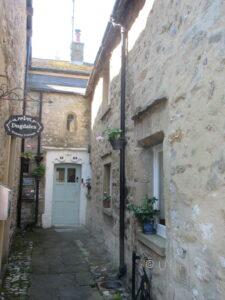
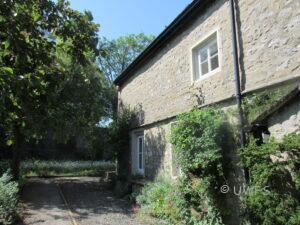
Used to be three cottages. Photo Phyllida Oates
It was a hot sunny day so we ambled slowly through so much of Settle’s long, immensely busy history, realising how little we had known of our near neighbour.
Preparation done by Frances and Marion.
Report and photos by Phyllida.